
Rare archaeological casts rediscovered in storage
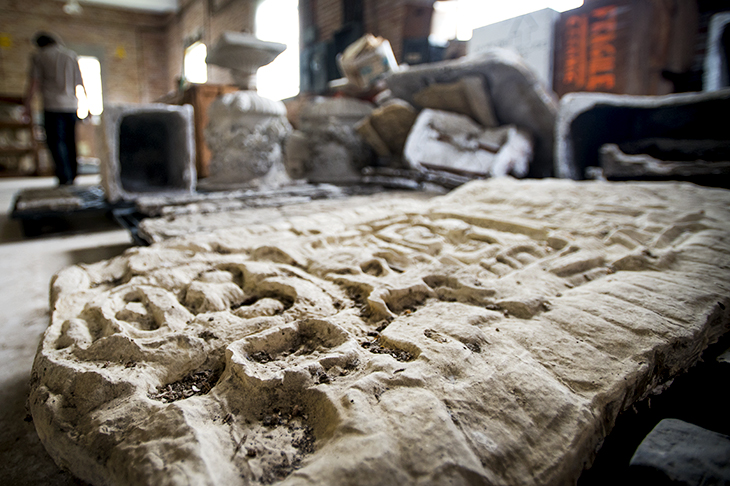
“It is fascinating to find a reference to a plaster cast of a Maya stela in an old letter from 1934 ⦠to learn that the cast was made in the 1890s and viewed by millions of people at the World"s Columbian Exposition in 1893, and then later recover that same plaster cast in an old World War II bunker,” says Caroline Parris, Middle American Research Institute collections manager. (Photo by Ryan Rivet)
The unassuming former ammunition shed in Belle Chasse, Louisiana, held a secret. Hidden inside its depths were rare 19th and early 20th century casts of ancient Maya monuments.
As the Middle American Research Institute (MARI) inventoried Tulane University"s holdings last fall, references to architectural casts not in immediate possession kept appearing. MARI director Marcello Canuto suggested visiting a Tulane storage facility in Belle Chasse, where MARI objects were stored nearly four decades ago. On the first visit, the team realized the collection of casts was larger than imagined. The institute rapidly assembled a team to uncover the contents of the Bunker 28 Tulane storage facility at the F. Edward Hebert Research Center.
What they found was startling. Stacked amidst rolls of fencing and old classroom desks were priceless casts of Maya monuments.
“They all have a great value within their historical contexts,” notes Caroline Parris, MARI collections manager. “Many were displayed publicly during the height of American fascination with prehistoric Mesoamerican cultures.”
The casts were used not only by colleges and universities, but also were exhibited in traveling exhibitions such as Chicago"s 1933 World"s Fair.
Graduate student Rachel Horowitz was thrilled to be included on the team.
“Being part of the project provided me with a greater understanding of the history of Maya archaeology, particularly how the Maya monuments we know about have changed due to environmental factors since their discovery,” Horowitz says.
The casts bear hieroglyphic details that have since eroded on the monuments themselves. These details could aid in decoding hieroglyphic texts.
However, it was almost too late. They could have been lost. The current state of the bunker provided a problematic home for such important pieces. Recent damage to the windows left the monuments vulnerable to weather and the depredations of rodents and insects.
The Zemurray Foundation saved the day with a timely grant. Thanks to the assistance, MARI immediately began working to catalogue and protect these rare casts for future generations of Tulane researchers and students.
Mary-Elizabeth Lough is a development writer in the Office of Development Communications.
“Many were displayed publicly during the height of American fascination with prehistoric Mesoamerican cultures.”—Caroline Parris, MARI collections manager
