Tulane engineering students build Formula-style race car as capstone project
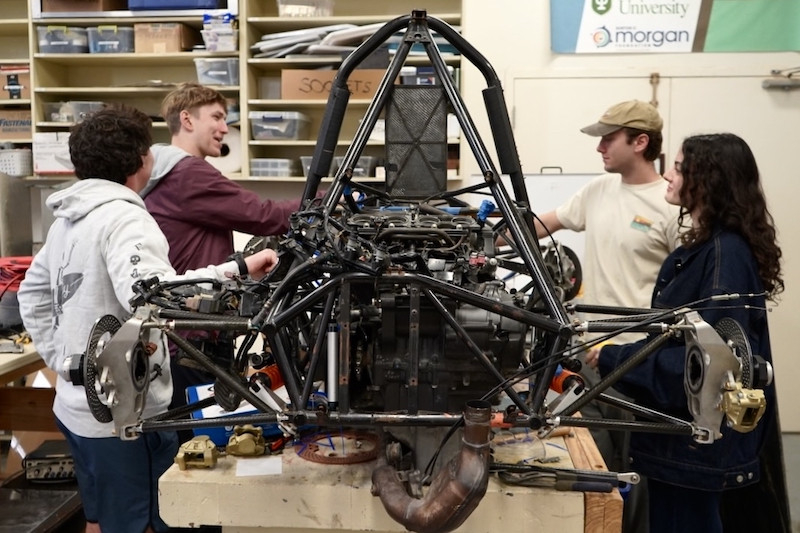
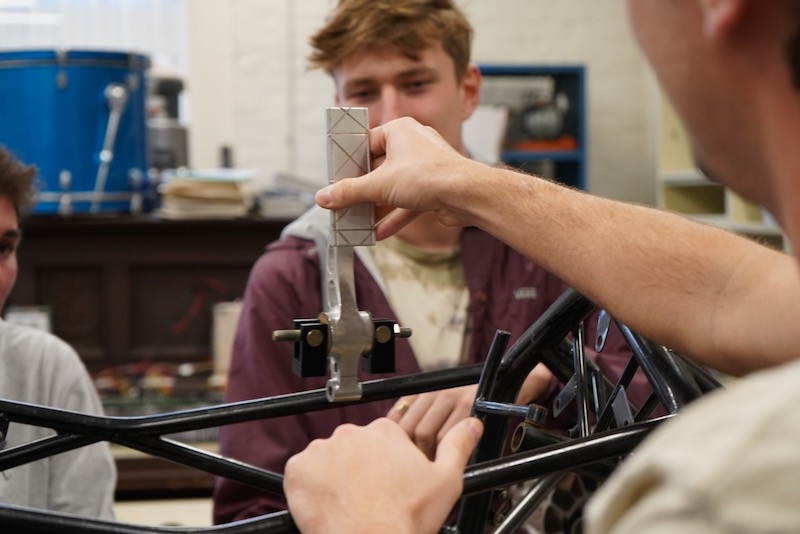
A team of Tulane University School of Science and Engineering seniors is building a Formula-style race car from the ground up as part of a capstone project that will debut at the university’s Engineering Capstone Design Expo on April 23.
The student-built vehicle is designed to serve as the foundation for Tulane’s newly established Formula SAE program and for use by future competition teams. This project is the first time Formula SAE, an international student engineering design competition, has returned to Tulane since Hurricane Katrina.
Through the design and fabrication process, the students aim to produce a reliable, drivable car that demonstrates the university’s engineering capabilities while creating a framework for continued development in the years ahead.
The project also marks Tulane’s entry into a collegiate competition organized by SAE International, formerly known as the Society of Automotive Engineers, where teams are evaluated on both engineering design and on-track performance.
Formula SAE competitions challenge students to design, analyze and manufacture a formula-style race car under strict rules governing safety, performance and cost. Teams are judged in static categories such as design, cost analysis and business presentation, as well as dynamic events including acceleration, endurance and fuel efficiency.
Working within tight time and budget constraints, Tulane’s team is applying classroom knowledge to a complex, real-world engineering challenge — building a race car that not only runs but performs.
The five-member team — Trevor Kaskade, Miranda Gomes, Brice Busch, Ryan Ehnot and Elizabeth Itskovich — began the project without a previous vehicle to build on.
“We started from scratch with an assortment of parts,” said Kaskade, a senior studying engineering physics with a minor in mechanical engineering. “A lot of other teams have years of experience and previous designs to work from, but our goal was to get a working car built and establish a foundation for future teams.”
The project is funded by Tulane Formula Racing, a student organization that hosts car-related events on campus and brings together students interested in automotive design and racing. While the club has worked with vehicles in the past, the capstone team is approaching the project from a more engineering-focused perspective, emphasizing design analysis, materials and performance optimization.
“We’re taking it more from an engineering perspective rather than just an automotive background,” said Gomes, a senior in engineering physics. “This is really about creating a new path for the program.”
Unlike the high-speed circuits of professional racing, Formula SAE competitions emphasize agility and responsiveness on tight, technical courses — a focus that shaped the team’s design priorities.
“We focused on strong acceleration out of sharp turns, even if that means a slightly lower top speed,” Kaskade said.
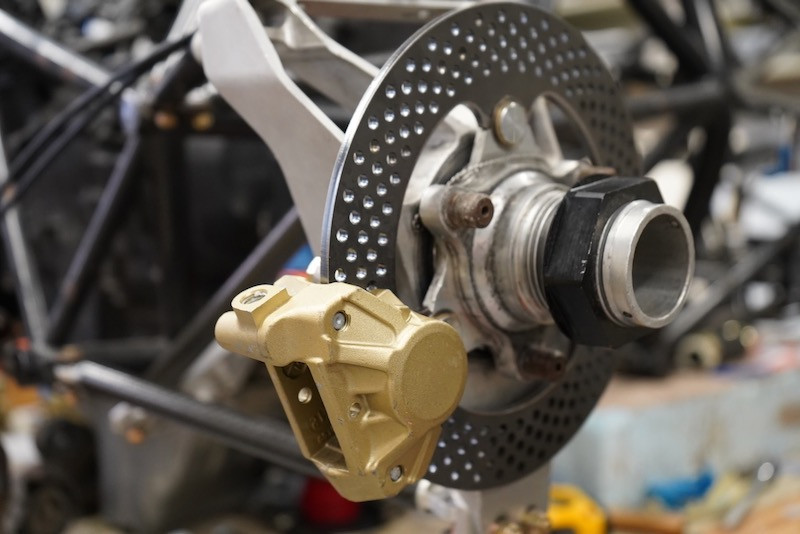
Each team member leads a major subsystem of the car, from drivetrain and suspension to steering, braking and structural components. Gomes serves as materials and ergonomics lead, working with lightweight composites such as carbon fiber while ensuring the vehicle meets strict safety requirements.
“The more carbon fiber we can use, the lighter the car will be and the faster it can go,” Gomes said. “At the same time, we have to make sure everything meets safety standards.”
Beyond the technical work, the project has pushed students to manage timelines, budgets and communication across a complex build.
“It’s putting together something with a lot of moving parts, and everyone has to coordinate,” Gomes said. “You’re managing a budget, working with a client and making sure everything fits together on time.”
For Kaskade, the experience has been a chance to bring classroom concepts to life.
“It allowed me to take what I’ve learned in class and apply it to something tangible,” he said. “You have to be willing to fail, iterate and improve — and plan for that.”
The team plans to showcase the car and a demonstration video of it in operation at the Engineering Capstone Design Expo at the Qatar Ballroom and Kendall Cram Room in Lavin-Bernick Center for University Life on Tulane's Uptown campus on Thursday, April 23, from 9 a.m. to noon.
Other projects being shown at the Expo include:
- BAND, a smart, biocompatible wound dressing that monitors humidity and temperature in real time to track healing progress. By reducing the need for frequent dressing changes, the device aims to lower infection risk and improve outcomes for patients with chronic wounds.
- exoStride, a wearable device designed to help individuals with foot drop walk more naturally. The system dynamically lifts and lowers the foot during each step, improving mobility while reducing the risk of tripping and secondary pain.
- Lullabi, a soft robotic sleep sack designed to help stabilize infant breathing. Using gentle, randomized vibrations, the device aims to reduce risk factors associated with sudden infant death syndrome while prioritizing comfort and safety.
- An accessible health tracking app, which allows blind and low-vision users to independently monitor and record personal health data. The platform integrates haptics, sound-based feedback and AI-assisted features to make health tracking more comprehensive.