
Class of 2026 student speaker to deliver message of hope, perseverance and purpose
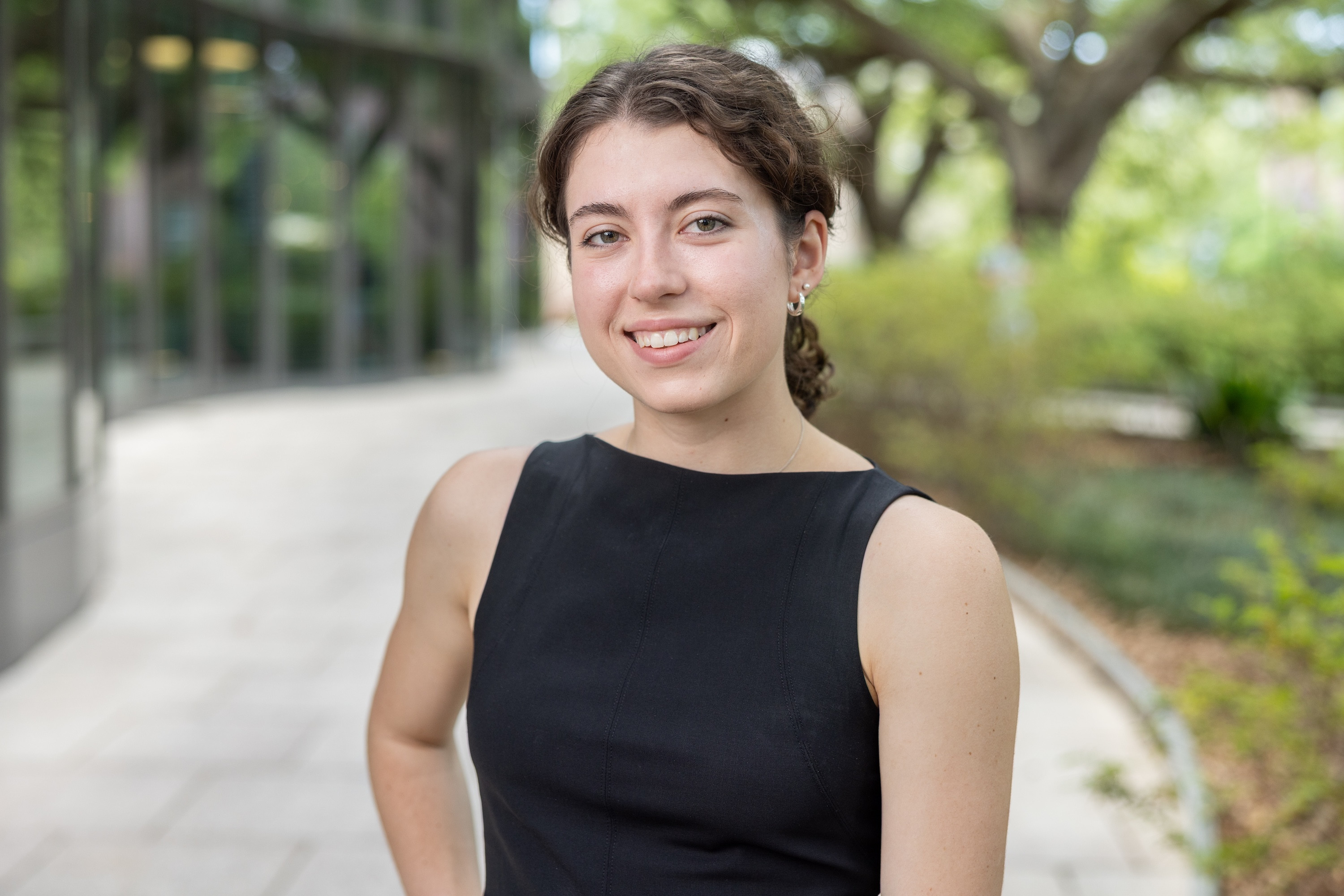
The thought of serving as student speaker at Tulane University’s Unified Commencement on Saturday, May 16, never crossed Madeline “Dylan” Murray’s mind — until her mother sent her a screenshot of the application from a Tulane parents' Facebook group a week before the deadline.
“I was making all the usual excuses,” she said. “Oh, I’m too busy. Oh, I’ll never get chosen.”
Then, the night before the application deadline, she sat down and wrote a rough draft of a potential speech.
Much to her surprise, the selection committee tapped Murray to stand before her classmates at Caesars Superdome and deliver what she hopes will be a message of hope, perseverance and purpose.
Like many graduating seniors, Murray, a psychology and computer science major in the School of Science and Engineering, wants to make a difference in the world. She got a taste of that as a sophomore when she became co-founder and chief operating officer of Exactics, a biotech startup developing at-home tests for infectious diseases.
The company has developed TICK Test, a fast, affordable screening test for Lyme disease. With that product set to launch this summer, the company is now developing a new device capable of testing for multiple diseases.
For Murray, however, her Commencement speech will not be about promoting her company. While she plans to reference it, her goal is to speak honestly about uncertainty, fear and the courage it takes to change course.
Murray knows firsthand what it means to change course.
She did just that when she decided to transfer to Tulane from the University of Chicago following her first year as a pre-med student. During an Easter visit to New Orleans, the New York native toured Tulane’s uptown campus and quickly connected with both the city and the university.
Although she had already been accepted to Northwestern University and assumed that’s where she would go, something about Tulane made her rethink her plans.
“Everyone I met was so happy,” she said. “When I got to the airport to go home, I remember hearing a jazz band. And I said, ‘I have to do this. I have to apply to Tulane.’ When I was accepted, I said, ‘I will never forgive myself if I missed out on the opportunity to just try it out, to follow this feeling and go to Tulane.’”
At Tulane, Murray immersed herself in campus life. She served as a first-year resident advisor in Wall Hall, worked as a teaching assistant in computer science and helped develop an independent study that became a higher-level elective course, “The Art of Functional Programming.” She also worked as a student aide in the Physics Department, mentored younger students interested in entrepreneurship and performed in both the a cappella group NJBeats and the improv comedy troupe Unscripted Improv.
She continued pursuing pre-med, but her plans to become a physician shifted when her former biology lab partner at the University of Chicago, Julian Kage, asked if she wanted to help with a pitch competition for a new company, Exactics.
She flew to Chicago to help with the pitch and found the experience so energizing that she began interning for Exactics. A short time later, she became a co-founder and chief operating officer, alongside Kage, Zachary Sarmoen and Maxwell Almeida, also from the University of Chicago.
Today, Murray leads business strategy, builds academic and industry partnerships and oversees team operations for the company. Through pitch competitions and fundraising, Exactics has raised more than $1.5 million. After graduation, Murray will help lead the company’s move to Boston, where it will establish its new headquarters.
But now, as she prepares to address the Class of 2026, Murray hopes her message will resonate with graduates who may be questioning the path they thought they were supposed to pursue.
“We are guaranteed nothing. We have a limited amount of time,” she said. “If you have a dream, that is a subconscious direction for where you were meant to go.”