
A match no algorithm could predict: Tulane professors built a partnership on collaboration
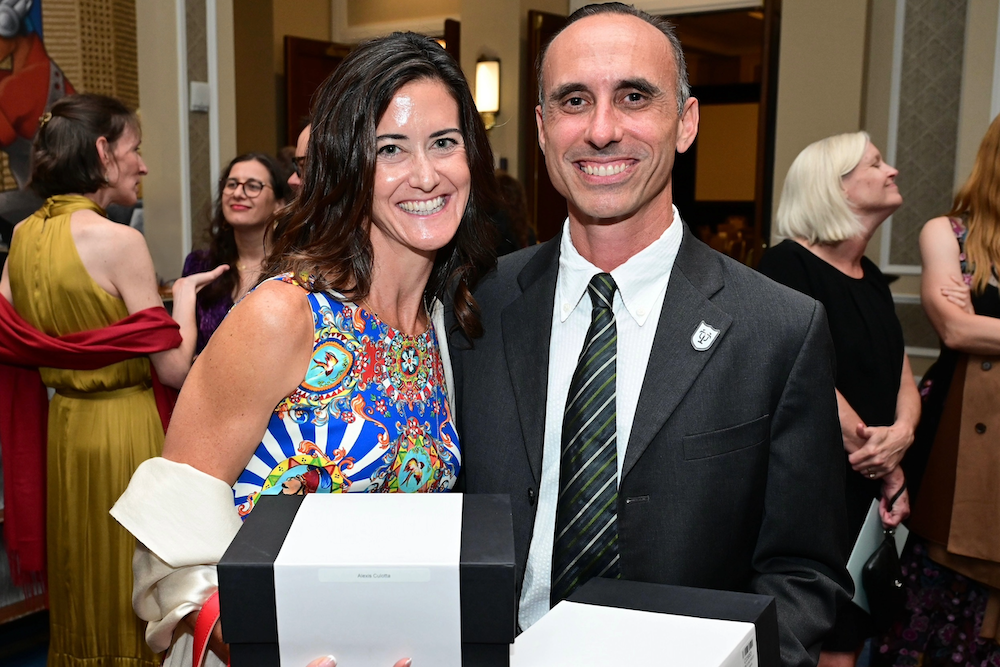
When Aron and Alexis Culotta met in graduate school, no algorithm could have predicted their partnership and marriage. He was a computer scientist studying social networks and data analysis. She was an art historian researching Renaissance workshops.
"There was this one computer scientist who happened to know a few art historians," Aron recalls. "When we started having parties in the computer science department, he was the connector that brought the art historians over."
That human bridge, what Aron calls a "node with high betweenness centrality" in network analysis terms, made their relationship possible.
Nearly two decades later, the Culottas have built their partnership on a different kind of collaboration, one that now includes artificial intelligence as a tool, not a replacement for human judgment.
The Culottas' early conversations didn't center on computer science or art history. Instead, they discovered shared interests and similar senses of humor. Over time, though, their research interests found unexpected alignment.
"The most simple point of commonality is the idea of collaborative processes," Alexis said on a recent morning on a Zoom call, sitting next to Aron. "How different cultures work together, how different artists work together, but also how people in the sciences collaborate, and how we collaborate with AI in the modern day."
That collaborative framework now shapes both their relationship and their research. The Tulane professors — Aron is the Nicholas J. Altiero Professor of Computer Science in the School of Science and Engineering; Alexis is Senior Professor of Practice, Art History in the School of Liberal Arts — have spent the past five years collaborating on a tool that uses AI and network analysis to reveal overlooked figures in art history.
The project emerged from Alexis's dissertation on Raphael's workshop. Through conversations and draft reviews, the two recognized parallels between her historical research and his computational work.
"What struck me about her thesis was it focused on the little guys, not the big-name people, but the lesser-known people who contributed a lot but didn't get credit," Aron said. "That's exactly what network analysis is about, identifying those who at first blush don't look important, but the way they connect things escalates their importance."
Alexis saw an opportunity to challenge centuries of scholarship that reduced the Renaissance to a handful of famous names, the "Ninja Turtles," as she puts it: Leonardo, Michelangelo, Raphael.
"We know that somebody like Raphael could not have succeeded on his own," she said. "There was this web of artists around him helping him complete all these projects in a very short period of time. It's a way to reassess and think about those relationships, which is really exciting."
Their collaboration has pushed both of the Culottas to reconsider their disciplines. Aron has learned to model nuance rather than abstract it away.
"Any one edge in the network could have had 50 dissertations written about it," he said. "Did this person create this? How did they create this? Trying to represent that complexity so it's not reduced down, so the humanities can do that deep investigation they're so good at, that's been the challenge."
In their classrooms and research, both Culottas emphasize a principle: AI should never replace human judgment.
"You never want AI to replace human judgment," Aron said. "The humanities have a lot to offer in terms of that perspective and what makes humans special, the ability to make those judgments."
"I try to frame AI as a collaborator, a tool that can help them organize thoughts, investigate ideas, but not [think] for them," Alexis said.
Their approach reflects a broader ethos at Tulane: that mastering AI requires what President Michael A. Fitts calls "human fluency." In a recent Forbes column, Fitts argued that universities must develop students' emotional intelligence, creativity and interpersonal skills alongside technical AI proficiency.
The Culottas' partnership continues to evolve around the same collaborative principle that brought them together, the recognition that meaningful work happens at intersections, through connections that can't be reduced to simple algorithms.
"Critical thinking is triply important these days," Aron said. "Being able to be skeptical and question things."
It's a framework they apply to research, teaching and relationships. AI can identify patterns, compile information and suggest connections. But it takes human judgment to decide what matters, what to trust and what to build together, he said.
Would AI have matched them two decades ago? When asked that question, both laugh.
"I guess if it was a good AI, then yes, if it asked the right questions," Aron said.