
It’s never too late: Tulane med students who took the long road
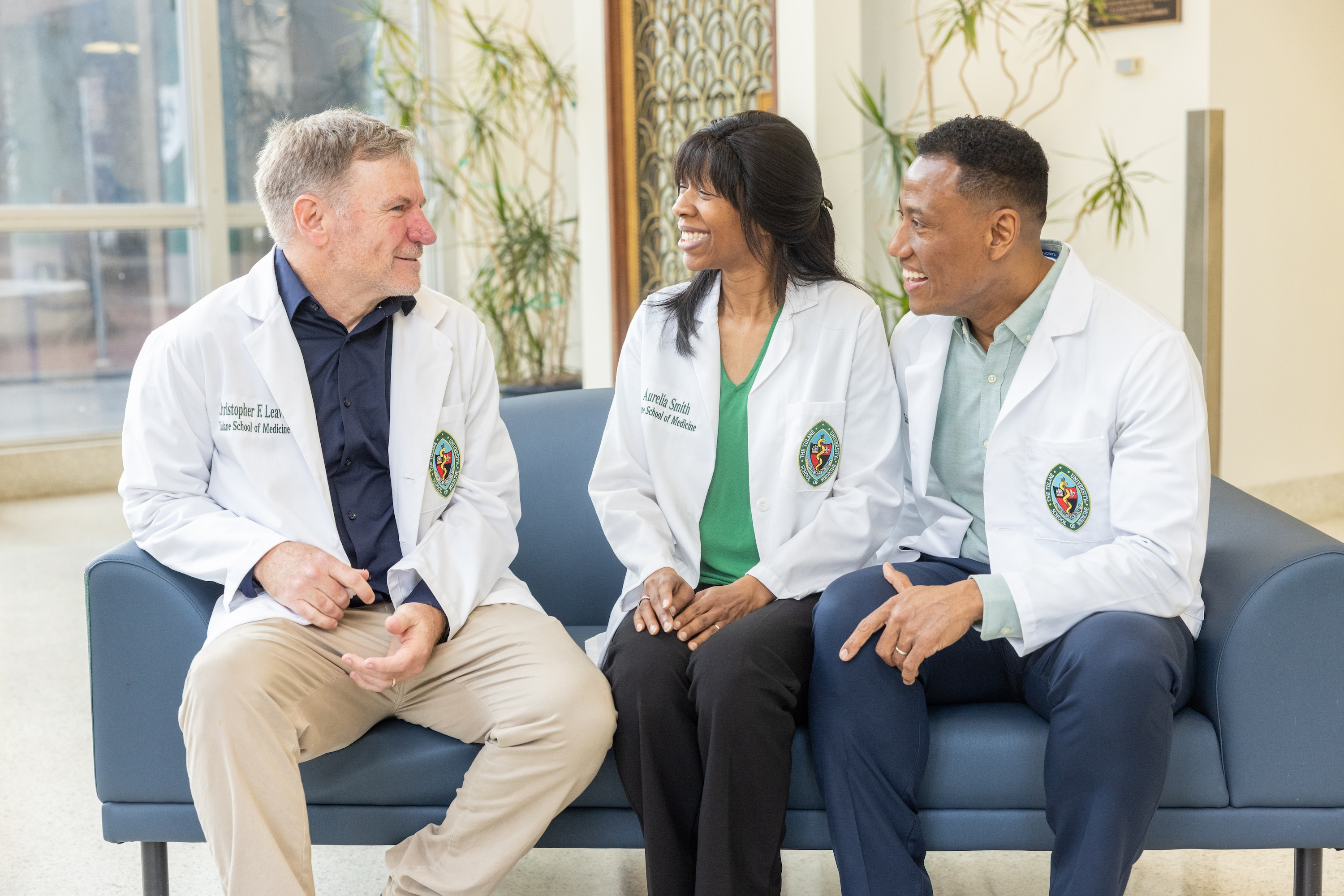
When you picture a medical student, odds are the image that comes to mind is of a bright-eyed student, straight from their undergraduate studies, with a stethoscope and a stack of textbooks.
While many students do choose to attend medical school directly after graduation, that’s not the case at Tulane, where the majority of students take at least a year or more between their undergraduate degrees and entering the School of Medicine.
“Having a large number of nontraditional medical students only adds to the educational enrichment of all our students,” said Michael Woodson, director of admissions for the School of Medicine. “I always tell our students that their medical education will not only come from our great faculty but from each other’s life experiences.”
A lifelong dream realized
Christopher Leavey has dreamed of being a doctor since he was 10. It was his pipe dream — the job that he would want to do if he knew he could not fail.
That, or being a quarterback in the NFL.
It was a dream he kept, even during a decades-long career in the Air Force Judge Advocate General’s Corps, where he was known as a “JAG.”
He was working as a JAG in Nigeria when a colleague mentioned classes he could take as a bridge to medical school. That’s when he realized he had not missed his chance to pursue his dream.
“My family and I hesitated. Starting medical school at 53 meant four years of real challenge and sacrifice,” he said. “But I was going to turn 57 either way, and I wanted to spend those years doing something meaningful — becoming a doctor.”
Leavey, now in his third year of medical school, says that between travel and other demands of his job as a JAG, he learned to roll with the punches, an ability that has served him well as a student.
“Like everybody else, I bring my entire past into everything I do,” he said.
Though many of the students around him in classes and rounds are younger than some of his own children, Leavey has nothing but admiration for his classmates.
"It's reassuring to be among these individuals, and to see how generous they are. They're smart, they're driven, they're inquisitive, and maybe most of all, they're kind," he said.
Dedicated to service
Former Air Force F-16 fighter pilot and test pilot Nate Smith has built his life around service. From his time as a 17-year-old cadet at the U.S. Air Force Academy, to his decision to attend Tulane medical school, serving others has been his driving force. In the Air Force, he found a community of people equally dedicated to service.
"I remember looking out my F-16 cockpit during a combat mission and seeing a fellow pilot whose sole mission that day was dedicated to providing immediate combat search and rescue and thinking, 'this guy doesn't know me, but no matter what, if something happened, he is immediately going to risk his life to save mine.' And it was just a surreal and comforting feeling, knowing that people are that committed to each other and to the mission," he said.
Smith doesn’t see med school as the next step in a lucrative career but rather as the ultimate chance to serve his community.
“It’s just about giving back and serving ... that would be my goal, to do that with excellence, and do it with compassion, and do it with care,” he said.
Smith made another unusual decision: to attend medical school alongside his wife, Aurelia Smith. “It’s been great,” he said. “I would not have it any other way.”
From patient to doctor
Aurelia Smith looked for years for answers to her long-term chronic illness. Now, as a second-year medical student, she is becoming better equipped to use her experience as a patient to help others.
“When you’ve experienced some of these things, they are not theoretical to you. You know what some of these things feel like. You understand how diagnoses can be missed,” she said.
After attending the U.S. Air Force Academy, where she studied political science, Smith worked in intelligence in the Air Force. Later, she became a faith-based counselor for women on the bases where she lived with her husband, Nate Smith, and their children. That experience led her to alter her path yet again.
“To be able to walk alongside other people who have suffered like I have, who have interacted with teams of physicians trying to work with you to figure things out and to better your life, that’s a huge impetus for me wanting to do this,” she said.
Aurelia Smith is part of the Doctor of Medicine/Master of Public Health dual degree program offered through the School of Medicine and the Celia Scott Weatherhead School of Public Health and Tropical Medicine. The program provides her with the opportunity to lean into her long-standing interest in political science.
“I have a desire to advocate for communities who struggle to get the care they need,” she said, “or sometimes are not listened to by providers.”
Woodson said that life experiences like those of Leavey, the Smiths and other nontraditional students enrich the education and community of all at the School of Medicine.
“Our students can learn from former lawyers, nurses, military personnel and others about the various life experiences that contributed to their call to pursue medicine,” he said.
